
8th October 2024 – Strumble head Pembrokeshire
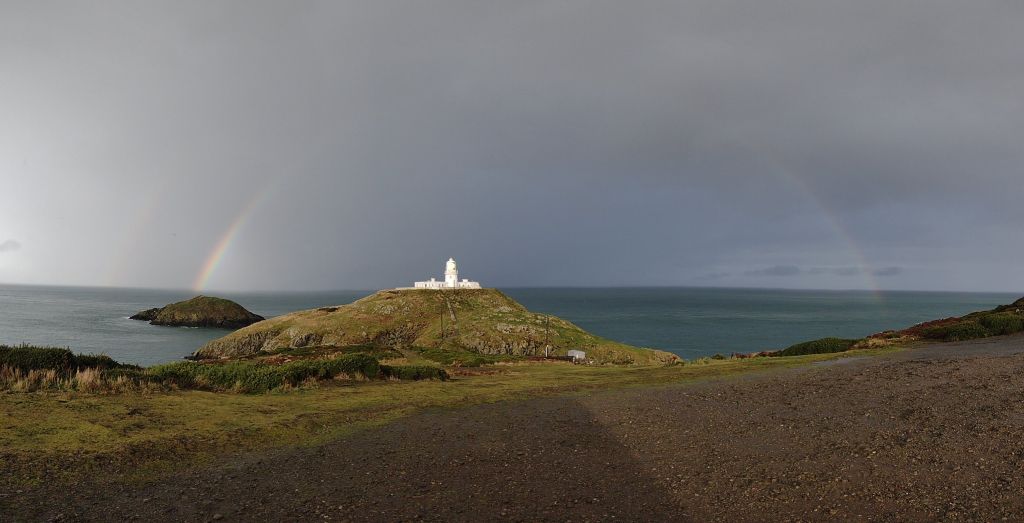
Dramatic blues and greys of sky and towering cumulus clouds.
Every Tuesday I spend a couple of hours with a two or three other volunteers, looking out to sea from Strumble head trying to spot and photograph harbour porpoises. This is part of a long-term project to monitor local population dynamics.
Often the two-hour watch involves not much more than getting extremely cold, but occasionally something different happens and this morning was one of those mornings.
I had arrived early as had I camped nearby. Stupidly I had parked on a slope and well within range of the Strumble head lighthouse light, making sleep practically impossible. But as I have noticed before, lack of sleep can sometimes leave one feeling strangely relaxed and well and this was the case this morning. Stepping out of the van, the dramatic sky, rocky coast and the sound of choughs firing their 1970’s arcade game laser calls at each other nearby, quickly made the escapade feel less of a misadventure.
The sky was an early-morning blue, against which the deep threatening greys of storm clouds, rather than creating a feeling of gloom, served to bring out the colour in the nearby grass and rocks. During my first coffee, the atmosphere, getting into its stride, combined the sun and an incoming rain shower to build a double rainbow; faint along most of its arc, but bright just where it entered the sea.
This was, perhaps, reward enough for an uncomfortable night, but things got better. I had been keeping an eye on the sea as, on a previous occasion, I seen a pod of Risos dolphins from this point, when I noticed a large flock of gannets, some settled on the sea, but others flying and diving. The gannets were some distance out from the shore, but as large white birds, and catching the sun they shone out against the grey clouds.
Seeing gannets, even though they are relatively common, is always something of a treat as they are big dramatic birds, but to see them on-mass like this was especially nice. It was more than this though, as I had learnt that gannets are often pointers to something more. I reached quickly for the binoculars and within a few seconds of locating the flock I saw the first fin break surface. Then there were more. At one point six fins and curved backs broke surface together, but there were more, many more than six; probably somewhere between one hundred and two hundred common dolphins, feeding together and creating the appearance of what I have heard other volunteer spotters refer to as dolphin soup.
This was all before the start of official survey period and I only had my personal camera with me rather the high-resolution telephoto cameras of the Ocean Lab project. However, I clicked away taking what photographs I could, before the pod moved out to sea.
Strumble Head is a remarkable spot for wildlife. It sticks out into the sea and constrains the currents that flow up and down the coast with each change of the tide. Coupled with a rough and broken sea floor the effect is to produce an energetic ribbon of turbulent sea known as a tide race. Six years of nearly daily survey results clearly show increased porpoise activity at around two hours either side of high tide, when the race is at a maximum, stirring up nutrients and disorientating the local fish stocks, making them easier for gannets, dolphins, porpoise and other predators to feed on. Strumble is also something of a departure and arrival lounge for many migrating birds. This morning there are swallows over the cliffs and further out to sea, preparing for their imminent departure, to Africa or other warmer countries.
I joined the other volunteers in front of the brutalist, Second World War coastal observation post which offers some minimal shelter from winds from any quater, other than north and before long we spotted many more gannets and dolphins further out, beyond the race. There were also black Vs of common scoater, a true sea duck, flying low over a bright sea.
Porpoises appeared around halfway through the survey; smaller groups of twos and threes, further out to start with, but moving closer as the survey progressed.
About 12:30 a merlin flew along the cliff top – a bird I had not seen before I started helping with these surveys. The final treat, and the highlight of the morning came just after this, when one of the more experienced volunteers called out ‘Thresher shark’ and indicated toward a bright orange buoy some hundreds of yards out to sea. Three sets of binoculars swung to look and just in time I saw it erupt vertically from the sea; the immensely long tail a full three feet clear of the surface. A wiggle or two and it fell back with a splash. Too fleeting for anyone to have got a photograph, but a clear view and characteristic thresher shark behaviour.
And that was it. From waking up at about six thirty, to now, O’clock, it had been one treat after another. It was not just the individual sightings, but the way these had been embedded within less tangible elements; the dramatic sky, the rainbows, the cliffs, the light, the smell of the morning, and even my insomnia induced relaxation. All these had combined to produce a wonderful whole.
After a morning like this phrases come to mind like “wildlife crisis? What crisis?”, but of course we all know there is a crisis and niggling doubts are always close; ‘why are there so many dolphins?’ ‘is it because they are being forced to the coast by the overfishing of deeper sea fish stocks?’ etc, etc. The days of unalloyed joy in natural spectacle seem gone for ever, but nevertheless, what a joyful mornin.
9th September 2024 – Mynachlog-ddu, Preseli hills
Grey windy and chilly
There was a music session in the Tafarn Sinc pub last night. Some younger musicians turned up by chance, resulting in a bit of a blues jam – very enjoyable. Long before I knew I would live in West Wales the Tafarn pub was a favourite place. Sawdust on the floor; situated in the odd ex-mining village of Rosebush, it seems a place apart; orthogonal to the rush and stress of the modern world.
I am parked next to Waldo Williams memorial. Waldo Williams was a local Welsh langauge poet and pacefist who lived here during his childhood when his father was head master at the local school.
Two lines from Waldo Williams poem 'Preseli' are engraved on the memorial.

"Mur fy mebyd, Foel Drigarn, Carn Gyfrwy, Tal Fynydd
Wrth fy nghefn ym mhob annibyniaeth barn"
which has been translated into English by R.H.Evans1.
"The Wall of my youth, Bare Three Cairns, Saddle Cairn, Tall Mountain,
Behind me in all my independence of opinion"


The purpose of my setting this investigation up as a real time exploration, rather than attempting to write a more carefully structured book or article, is to allow myself to focus on the questions rather than on style.  For this reason I am just going to jump in here and maybe flounder around for a while….
The point is that these two phenomena, the sand ripples and the birds, have, as examples of emergence, a broader significance. Emergence is a significant idea in philosophy – worth, for example, a sixteen thousand word article in the Stanford Encyclopaedia of Philosophy2..
Philosophical ideas can have a tendency to be complex and nuanced and, quite often, ill-defined. The concept of emergence is, I would say, all of these things. Fortunately there are philosophers who have the ability to cut through confusion to produce a clear crystallisation of ideas. David Chalmers is, in my opinion, one such philosopher. Perhaps most well known for his coining of the term ‘The hard problem’ in describing the difficulty of explaining how physical matter can give rise to the subjective experience of consciousness3., David Chalmers has written on many other topics in philosophy, including emergence4:
“The term ‘emergence’ often causes confusion in science and philosophy, as it is used to express at least two quite different concepts. We can label these concepts strong emergence and weak emergence. Both of these concepts are important, but it is vital to keep them separate.”
On weak emergence David Chalmers says;
“We can say that a high-level phenomenon [e.g. sand ripples or a murmuration] is weakly emergent with respect to a low-level domain [saltation rules or boid rules] when the high-level phenomenon arises from the low-level domain, but truths concerning that phenomenon are unexpected given the principles governing the low-level domain. Weak emergence is the notion of emergence that is most common in recent scientific discussions of emergence, and is the notion that is typically invoked by proponents of emergence in complex systems theory.”
So, what this is saying, is that a phenomenon is weakly emergent when it arises from simple lower level rules, but the complexity that emerges is somehow surprising and could probably not be predicted from knowledge of the simple rules.
For example, could we have predicted the complexity of sand ripples had we only been told about the process of saltation? Or the beauty of a murmuration given only the boid interaction rules?
Of ‘Strong emergence’ David says;
“We can say that a high-level phenomenon is strongly emergent with respect to a low-level domain when the high-level phenomenon arises from the low-level domain, but truths concerning that phenomenon are not deducible even in principle from truths in the low-level domain. Strong emergence is the notion of emergence that is most common in philosophical discussions of emergence, and is the notion invoked by the British emergentists of the 1920s.”
So, the essential difference between weak and strong emergence is that in weak emergence all higher level behaviours arise out of the low level rules, whereas in strong complexity they do not. In strong emergence something truly novel comes into play at the higher level, i.e. the higher level system is more than the sum of itys parts.
Looked at in this way, weak emergence appears to be essentially trivial. All it is really saying is that our human brains are not clever enough, or our imaginations not powerful enough, for us to foresee the complexities that can arise from repeated, large-scale application of simple rules. In this way, weak emergence seems to also correspond to what is known as ‘epistemological emergence’, i.e. apparent emergence, due to our lack of understanding or knoiwledge.
Strong emergence, on the other hand requires a system to be more than the sum of its parts and therefore goes against the reductionist view of modern science which holds that systems are precisely the sum of their parts – no more and no less.
Chalmers again summarises the situation nicely:
“In a way, the philosophical morals of strong emergence and weak emergence are
diametrically opposed. Strong emergence, if it exists, can be used to reject the physicalist
picture of the world as fundamentally incomplete. By contrast, weak emergence can be used
to support the physicalist picture of the world, by showing how all sorts of phenomena that
might seem novel and irreducible at first sight can nevertheless be grounded in underlying
simple laws.”
In this paragraph, the term physicalist refers to the world view, similar to that of materialism, that there is, in the world, only physical matter.
- https://thecuriousastronomer.wordpress.com/2016/03/11/pa-beth-yw-dyn-what-is-man-by-waldo-williams-poem/
- https://plato.stanford.edu/entries/properties-emergent/
- Chalmers, David (1995). “Facing up to the problem of consciousness” (PDF). Journal of Consciousness Studies. 2 (3): 200–219.
- https://consc.net/papers/emergence.pdf
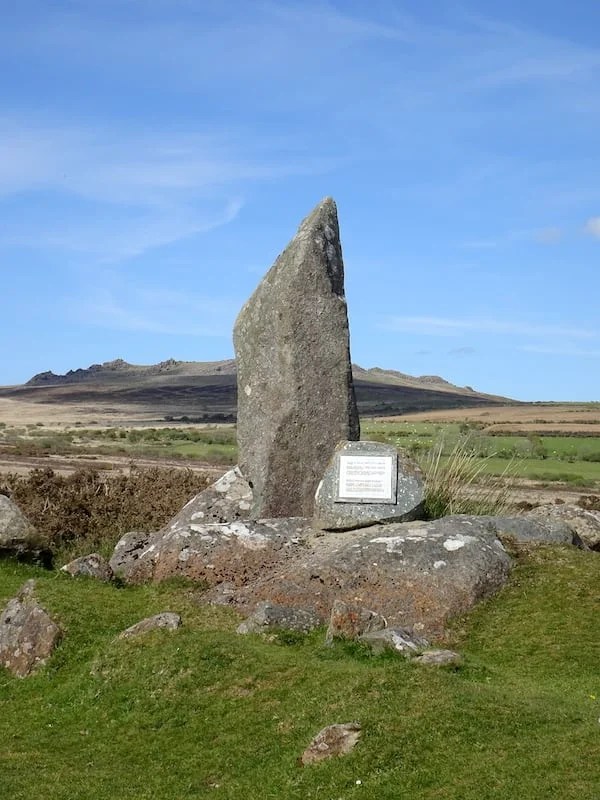
Waldo Williams’ memorial stone near Mynachlog-ddu, with the Preseli hills in the background.
3rd September 2024 – Carn Enoch on the Preseli hills
The mist of last night has cleared to a cloudy dawn. It is 6.30 and I am wandering up the road. There is a delicious fresh smell of cool air and sheep; this year’s lambs are bleating and somewhere a buzzard mews repeatedly. As I walk I look around and wonder what the day’s weather holds in store – and then it catches me; I have no internet (a mix up over a new contract), so I have no choice but to wonder. But, what a delicious feeling; not knowing – just a little bit vulnerable to uncertainty. And then the feeling of wondering and uncertainty come together with the smell of the dawn, the buzzard and the bleating sheep – and I am caught off guard by a breaking wave of nostalgia; back in the world of my childhood and youth. Some morning in the late sixties or early seventies; on the West coast of Scotland; up early to go birdwatching, binoculars around neck, all those same smells – and wondering about the weather for the day and the two week holiday to come.
Back in the van I have the computer before me and I am googling sand ripples. I have searched for scientific papers on sand ripples before, but the ones I found previously took a highly mathematical approach, modelling the detailed interaction of sand and water flow. This time however I have turned up a shorter article that hints at something more accessible1. a link to a piece of software2. that will simulate sand ripple formation.
I have always enjoyed computer simulations – they provide a tame world one can play with, enabling one to explore phenomena; simultaneously answering questions and prompting new ones. So, I download the software and in a few minutes have it running.
A detailed model of the complexity of interacting forces which contribute to sand ripple formation would require a very considerable computer code, if it were possible at all, but the computer code I just downloaded is tiny, just a few hundred lines long. So what is it doing? Looking further I see that the actual physics model embedded in this program is even shorter, occupying only a few tens of lines.
I read some brief notes which explain that the simulation incorporates only one key physical process – a process I have not heard of before called saltation. Saltation (Latin, to dance or leap) is the process whereby individual grains of sand are picked up by flowing water (or wind) and transported before being deposited again.
And that is all there is to the code. I run it and low and behold sand ripples appear on my screen, complete with the curious geometric features, such as the bifurcations, which intrigued me in the beginning.
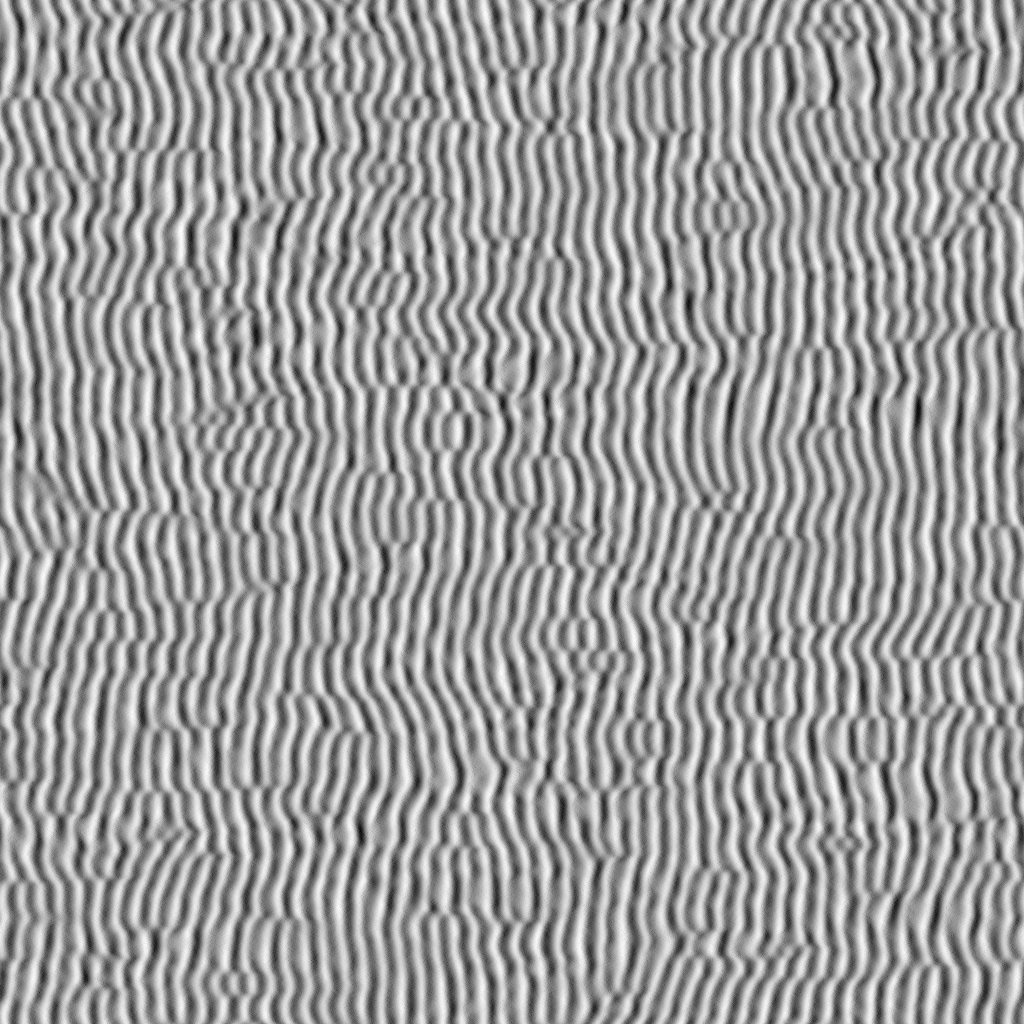
Simulation of sand ripples.
Could we have guessed that such complexity was implicit in such simple rules?
I am reminded of a little scientific exercise I carried out as a child, in which you sprinkle iron filings onto a piece of paper under which was placed a bar magnet. Encouraged by a little shake of the paper, the iron filings form a pattern; a series of gently bending lines running from one end of the magnet to the other. These lines reveal the previously invisible magnetic lines of force. It seems, for a moment, that the sand has done something similar. As if in some abstract mathematical space, we had sprinkled the sand onto the saltation rules and revealed their hitherto implicit, but complex potential.
More Google searching reveals that I am not the first to find and ripples intriguing and further, that sand ripple formation is an example of something known as an ‘emergent phenomenon’ of which other cited examples include, society, the stock market, patterns of traffic flow in cities and bird murmurations.
I have witnessed two bird murmurations; the first was some years ago, taking elderly friends to see a starling murmuration on some South coast marshes. We stood as twilight fell. A red sun dropping behind the scrubby trees and dark reeds. At first there were just a few birds, a small knot of maybe half a dozen, but then another similar group took to the air and joined, and gradually more and more birds were pulled out of the marshes. I don’t know how many there were in the end, but a huge mass, whose wings, when passing overhead, sounded like a rushing stream.
Back and forth; such complexity; like kneaded dough, stretched and pulling back, holes opening and healing, pulsations, over and over in front of our eyes. How do they do this, and why? The synchronisation, so perfect, so beautiful, creates an impression of signs and portents in the sky.
More recently, on the edge of The Wash, at the highest tide of the year, when a few hundred thousand waders are pushed off the mud and forced to the air. A sinuous sea monster, rearing up, with ripples running along its body. Variation upon variation for twenty minutes or so, before, like the big rocket at the end of a firework display, the end is unequivocally signalled by the main flock roaring low overhead on their way to nearby roosts.
The synchronisation of murmirating birds is so impressive, so beguiling that some early ornithologists felt obliged to moot psychic powers or avian telepathy as an explanation. But, while questions still remain, particularly around ‘why’ birds indulge in this behaviour, the questions of ‘how’ seem to have been plausibly answered.
In 1987 computer scientist Craig Reynolds created a simulation of flocking behaviour called Boids (Boids is an abbreviation of ‘Bird-oid object’ ) where the virtual birds in the system had to follow just 3 simple rules:
Separation – nearby birds had to move further apart
Cohesion – distant birds had to move closer together
Alignment – birds had to align their direction and speed with each other
Reynolds found that even with these basic rules it was possible to re-create murmuration behaviour.
So again, as with the sand ripples, all the complexity seems to arise from repeated aplication of simple rules.
- https://blog.durablescope.com/post/SandRipplePatterns/
- Tony Butterfield – Simulation of sand ripples, code adapted from work by Peter Lamb, Jordan Kwan and Sam Ahn May 1, 200, (www.math.hmc.edu/~hosoi/M164/sanddunes.doc)
2nd September 2024 – Carn Enoch in the Preseli hills
It is mid afternoon, but humid and misty. I can see neither the sea nor the hills – even the Carn Enoch rocks are hidden. The heather and gorse are in flower, but the colours are muted, the only birds have been a couple of black corvids; crows, or maybe they were ravens.
I am parked here for just a few hours before heading to Fishguard for a practice session with a welsh tunes music group I am part of. The amount and variety of music in this area is wonderful. Wales is known as ‘The Land of Song’ and the acceptance of, and fondness for music, seems, around here at least, to be alive and well. Long may it continue.
As I mentioned, sand ripples have always intrigued me. I once had an idea for some pieces of art which would incorporate ripple patterns using embossed paper. The inspiration for this came from a print I own which shows a toad crawling up a sand dune, where the marks left by its passage are embossed into the thick art-paper.
But despite these artistic inclinations my ponderings usually turn more towards science, or more specifically physics. Of course, even within physics there are nuanced perspectives and motivations. Mine would best be described as lying towards the philosophical, with maybe a bit of art or poetry thrown in! This, despite the fact that my career in physics was on the intersection of physics with engineering rather than with philosophy, but careers often involve compromise, unless you are one of the lucky few.
Let me be the first to admit, this intersection of physics and philosophy can be a dangerous area. People who are drawn to it may be looking for something beyond what may seem to be the sterile reductionism of mainstream science, and I suspect it is easy to look too hard, to see things that aren’t there and to clutch at straws. May every Mulder contain their own Skully!
Of course, the hardest thing to examine, or even to be aware of, are ones own unspoken assumptions. For example I just described mainstream science as ‘sterile and deterministic’, I am not the first to suggest this, and it can seem to be just that, but we must proceed carefully. What assumptions underlie this impression? Are they justified? What are the alternatives?
But all in good time. One has to choose an entry point into a topic and I have chosen sand ripples.
14th August 2024 – The Solway estuary.
Weather grey and windy.
I have been thinking about sand ripples. There were lots on the beach yesterday, as I walked back from the rocks to the shore.
As well as being aesthetically attractive there is something that, for me, borders on the magical about these patterns in the sand. Or rather, I don’t actually mean magical, but something about them speaks to me. I find it hard to pin down what this is, maybe because it is a conglomerate of different elements. Firstly, sand waves occur on the beach and are created by the sea, facts which already give them a poetic charge. They undoubtedly also pique my scientific curiosity, being the product of forces ranging from the capillary action between individual grains to the tidal effects of astronomical bodies. There is an element of mystery about them – how are they formed. They are big – running the length of the beach, with individual ripples running for many metres and they are also complex, with many braidings and bifurcations. They somehow speak of the cosmos. There, that last one; that feels right; ‘they speak of the cosmos’. Speech requires complexity, sublety and a subject and these ripples show an infinite variety of subtle form and like the wavy grooves of a vinyl record, present a recording of great richness .
So, sitting here this morning, looking out over the estuary and enjoying the peace and the first coffee of the day, I have started to dig and one thing has led to another and my sand ripples are showing every sign of turning into something of a rabbit hole. Or maybe, though it is hard to be sure at the moment, a veritable warren, with exits in many disparate and interesting places.
13th August 2024 – The Solway estuary:
An early morning walk along the Solway shore; the early sun, already warm. Soft air dotted and streaked with the piping of wading birds – mainly oyster catchers, but also occasional curlew and the beautiful, diminutive, ringed plover. The sand, rippled by the recent tide, is studied with cockle shells.
This estuarine coast, with what, writing about a different estuary, Dylan Thomas described as its ‘visiting sea’, is very different from the rocky coast of north Pembrokeshire that I am used to. The sand here is muddy, oozy and rich. Where I am standing it presents a star field of worm castes, the sight of which revives echoes of the unease these coiled excretions used to evoke in me when, as a bare-footed child, I used to plot courses between them as if they were mines.
This morning the sea is calm and the air has a bucolic feel, but a number of deep sea-sculpted holes in the nearby rocks remind me that this can be a wild and harsh environment. I imagine, in the winter maybe, when the geese are here, a storm funnelling up the estuary causing a two metre swell on top of a ten metre tide; the push of salt water meeting the downrush of the fresh; the denser salt cutting under and superimposing a wall of turbulence on the already powerful tidal flow. Such currents redistribute vast quantities of mud, sand and silt and shuffle and re-shuffle, the ever changing banks and channels of the estuary.
But not today. Today is gentle and beautiful. I walk a little further before the lure of coffee and a bacon sandwich overwhelms my curiosity and I turn back.
12th August 2024 – Late evening somewhere between Kilmarnock and Dumfries.
I look out of the van window, the view is pleasant if not startling; the gently rolling countryside of the east side of Dumfries and Galloway. There are soft headed grasses close to, moving in the breeze and a number of swallows swooping and diving over a small rise close to the van.
It is lovely, but I can’t help wondering why I am here and not an hour or so’s drive further north, when I would be in the real wild country, Glencoe maybe, or even further out on one of the islands. I hope it is simply a consequence of an increased inclination to appreciate more subtle elements of landscape – not needing to have one’s senses bludgeoned into wakefulness by towering peaks and cascading cataracts. What was it Nietzsche said?
The most noble kind of beauty is that which does not carry us away suddenly, whose attacks are not violent or intoxicating (this kind easily awakens disgust), but rather the kind of beauty which infiltrates slowly, which we carry along with us almost unnoticed, and meet up with again in dreams; finally.
This it feels sort of right, but a less hopeful thought nags; maybe this is just another sign of ageing. Don’t I remember my parents going through a similar transition. A gradual drawing in of the horns; holidays in Yorkshire rather than the wilds of Ardnamurchan peninsular or the Isle of Mull.
But, despite these doubts, it is truly lovely to be here. To have a little time to just Be. Weeks, months and years of what I am sure is nothing more than the ordinary stuff of life, or at least of life at the age I find myself, have made time to write, or even think, scarce. Even reading has, on the whole, been desultory and sporadic, with numbers of books started but not finished. When I have read, there has been a need for lighter material, novels or books about walking rather than philosophical tomes or works on the frontiers of science. A need for simple enjoyment and reassurance.
Don’t investigations into the real nature of things too often end in unease, sadness or, in some instances, something close to real horror? The saying ‘The truth shall set you free’ is a motto of a number of universities, including the prestigious California Institute of Technology (Caltech), but might this not be hopelessly optimistic? The more I read and think, the more I find myself wondering if it might not be at least equally likely that ‘The truth’ will bind us tight.
With regard to writing, even if the time and inclination are present, isn’t it still hard to say anything? Don’t thoughts, and inclinations, have a way of cancelling themselves out? Like pairing socks after emptying the washing machine, one starts with a pile of chaotic possibility, but one by one each argument or impulse finds its counter argument or impulse, until there is nothing left. Add to this, the tendency to wonder if one should say what one is inclined to say and the chances of committing anything to paper becomes vanishingly small. Straight is the gate and narrow is the way indeed.
But, despite this, it still seems important to try; to finally test oneself against ideas that have intrigued and and tormented for many decades and, if not now, then when?
So this is it. An attempt to push as far as possible into some of the big ideas and mysteries of life and philosophy. Not a book – I have tried to start to write books before, and always ended up bogged down in hopeless complexity, but a live real-time exploration. An exploration that, no doubt, will contain false trails, and back peddling but hopefully will be more real for that.
I am doing this for myself. Of course I hope one or two who may read this will come along, but as I am reasonably happy in my own company I am going to go on this journey anyway.
Maybe, if you come, we can just walk together, in companionable silence for a while and then, at some point, share a few quiet words, while sat on a rock looking at the view, over a cup of coffee.
 Jon James